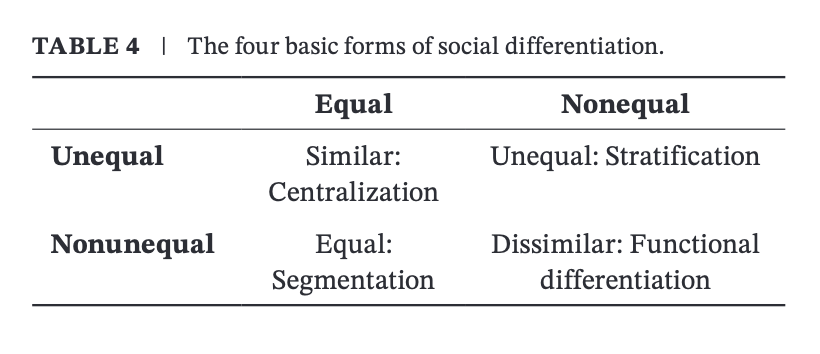
Abstract: This paper revisits and refines Niklas Luhmann’s framework for understanding social differentiation, addressing unresolved ambiguities in his original theory. Luhmann’s approach, which initially identified three core forms of social differentiation—segmentation, stratification, and functional differentiation—expanded to include a fourth form, centralization. By critically examining the theoretical underpinnings and limitations of Luhmann’s distinctions, this study shows how the four basic forms of social differentiation can be inferred from a cross-tabulation of the equality/inequality distinction, provided that this distinction is treated as a false distinction and decomposed into two true ones. This new approach not only resolves existing ambiguities but also enhances the analytical capacity of the theory, potentially extending its application beyond social sciences to other domains of differentiation.
Keywords: Social differentiation, true and false distinctions, cross-tabulation, digital social theorising.
The author accepted manuscript version of this article is available for download here.
Recommended citation: Roth S. (2025), The matrix reloaded. A revised framework for the inference of the four basic forms of social differentiation, Systems Research and Behavioral Sciences, DOI: 10.1002/sres.3131.

Leave a comment